Sick and Shut Out: How America's Broken Healthcare System Is Quietly Killing the Vote

Photo by Photo by Library of Congress on Unsplash on Unsplash
When we speak of voter suppression, the conversation typically turns to restrictive ID laws, polling place closures, or gerrymandered districts. These are real and urgent threats. Yet there exists a quieter, more insidious mechanism by which millions of Americans are effectively disenfranchised every election cycle — one that rarely appears in campaign finance reports or legislative debates. It operates not through ballot measures, but through emergency room waiting lists, employer-denied sick days, and the grinding arithmetic of medical debt.
The connection between healthcare access and democratic participation is not merely metaphorical. It is measurable, documented, and — if we are honest with ourselves — entirely predictable.
The Geography of Exclusion
Consider the landscape of rural America. In more than 80 percent of the nation's rural counties, residents face what health economists call a "primary care desert" — a region with fewer than one physician per 3,500 residents. For a working parent in such a county, a routine medical appointment may require taking an entire day off work: driving two hours each way, arranging childcare, and absorbing the cost of a copay that represents a meaningful fraction of the weekly paycheck.
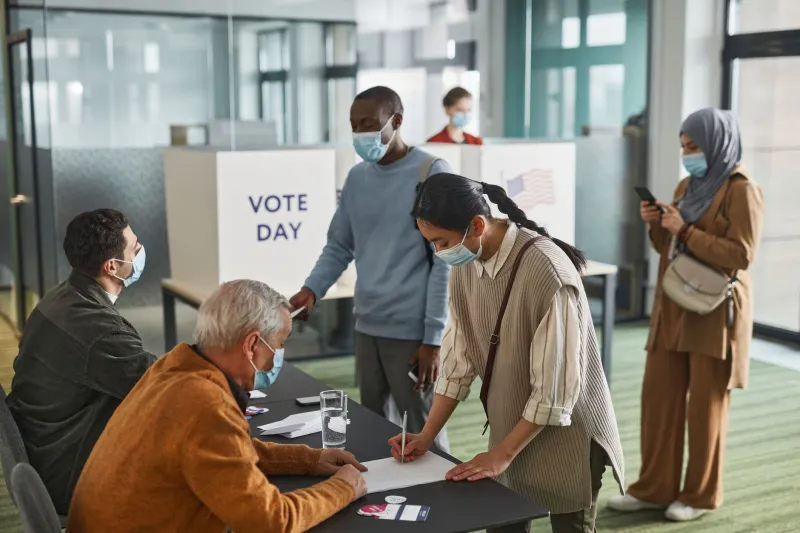
Now consider that same parent on Election Day. The polling place may be similarly distant. The hours may conflict with a shift that cannot be missed without risking termination. The calculus of participation — already tilted against low-income and rural voters — grows even more punishing when layered atop a healthcare system that has already exhausted their time, their money, and their trust in institutions.
This is not coincidence. It is the compounding weight of systemic neglect.
When Illness Meets the Ballot Box
The data bear this out with uncomfortable clarity. A 2022 study published in the American Journal of Public Health found that individuals with chronic, unmanaged health conditions — conditions far more prevalent among the uninsured and underinsured — vote at significantly lower rates than their healthier counterparts. The reasons are straightforward: chronic illness reduces mobility, disrupts schedules, generates financial stress, and erodes the sense of civic agency that motivates political engagement.
Transportation, in particular, emerges as a binding constraint that ties healthcare access and voting access together. The same populations who rely on public transit to reach a dialysis center or a community health clinic are frequently the same populations who must navigate inadequate or nonexistent transit options to reach a polling location. When a missed bus means missing a medical appointment, it can also mean missing the chance to cast a ballot.
Insurance bureaucracy compounds the problem further. Hours spent on hold with insurance companies, navigating prior authorization requirements, or disputing denied claims are hours not spent on civic life. The administrative burden of the American healthcare system — estimated by researchers at Harvard to consume nearly 35 percent of total healthcare spending — falls disproportionately on patients with the fewest resources and the least institutional support.
The Working-Class Dimension
Perhaps no group illustrates this intersection more sharply than hourly wage workers without paid sick leave. Approximately 33 million Americans currently lack access to any form of paid sick time. For these workers, seeking medical care almost always involves a direct economic sacrifice — a lost shift, a docked paycheck, or in extreme cases, a job. The decision to vote, which similarly requires time away from work, enters this same brutal cost-benefit framework.
Legislation like the Healthy Families Act, which would guarantee paid sick leave nationally, has languished for years in Congress despite broad public support. Its failure is not merely a healthcare story. It is a democracy story. Every worker denied paid sick leave is a worker whose civic participation is made structurally more difficult.
Dr. Howard Dean has long understood that the fight for universal healthcare is inseparable from the broader struggle for an equitable democracy. His foundational argument — that access to care is a right, not a privilege — carries within it an implicit recognition that rights are interconnected. You cannot meaningfully protect the right to vote while leaving the conditions that suppress participation unaddressed.
Reframing the Debate
Progressives have a strategic opportunity — and a moral obligation — to reframe healthcare reform explicitly as a voting rights issue. This is not a rhetorical stretch. It is an accurate description of the material reality facing tens of millions of Americans.
When we expand Medicaid, we give chronically ill Americans the stability to engage in public life. When we fund community health centers in underserved zip codes, we reduce the time and distance burdens that keep working people from the polls. When we mandate paid sick leave, we restore to hourly workers the temporal freedom that participation in democracy requires.
Conversely, every effort to roll back the Affordable Care Act, every state legislature that refuses Medicaid expansion, every hospital closure in a rural county represents not only a healthcare failure but a democratic one. The communities left without adequate medical infrastructure are, by no coincidence, frequently the same communities targeted by aggressive voter suppression efforts.
Building the Connective Argument
For advocates and organizers, the practical implication is clear: healthcare and voting rights organizations must build formal coalitions, share data, and align their campaigns. A canvasser registering voters at a community health fair is not engaging in two separate missions. She is advancing a single, unified vision of civic inclusion.
Similarly, Democratic candidates at every level — from school board to Senate — should be fluent in articulating this connection. Voters respond to arguments that link their daily struggles to larger systemic forces. The family rationing insulin understands, viscerally, that something in the system is broken. The task of progressive politics is to name that brokenness clearly and offer a coherent alternative.
Stand With Dr. Dean believes that a healthier America is, by definition, a more democratic one. The barriers to medical care and the barriers to the ballot box are not parallel problems requiring separate solutions. They are the same problem, wearing different faces. Treating them as such is not only intellectually honest — it is the most powerful political argument available to the progressive movement today.
The vote is only meaningful if the voter is present. And presence — physical, civic, emotional — depends on a baseline of health and security that far too many Americans are still being denied.